Intelligent robotics · Manufacturing
Flexible robotics for metal fabrication and welding.
VimaLabs builds modular, intelligent robotics to meet the challenges of flexible production in metal fabrication and welding.
More autonomous cells, able to handle part variety and real-world tolerances.
Less intervention for programming and re-referencing tasks, easier industrialisation for optimal production.
The challenge
Small-batch manufacturing is under pressure. Conventional robotics was not built for it.
71.3%
of welder hiring projects are rated difficult by French employers
versus 43.8% across all occupations.
Source: France Travail, labour needs survey (BMO) 2026
195 vs 449
robots per 10,000 manufacturing employees, in France and Germany
While robotics looks like a solution, France remains below the European average.
Source: IFR, World Robotics 2025 (2024 data)
Conventional robotics struggles with variety.
Every new part number needs its own programming, its own dedicated fixture and its own settings. The workload does not disappear: it shifts from the shop floor to methods and engineering, support functions that are also struggling to hire.
The result: in small batches the return on investment is not there, and most SMEs give up on robotics.
First use case
Automated loading / unloading of welding fixtures
Our observation is simple: in flexible workshops, even with robotic welding, it is still an operator who loads and unloads the parts.
A low-value task that causes musculoskeletal disorders…
… and forces people and machines to work in sync.
An observation that does not fit our vision of the workshop of tomorrow.
Autonomous. Makes your welding cell autonomous, including outside staffed shifts.
Adaptable. Handles part variety and real-world defects: varied shapes, tolerances, distortion, worn fixtures.
Backward-compatible. No need to redesign all your fixtures.
Our goal, a solution that is:
Our vision
Automating small-batch production. One vision, two pillars.
One platform, many manufacturing trades
Today
Welding
Next
Assembly
Next
Finishing
Next
Painting
Next
Machining
Pillar 01 · Technology
Autonomous & adaptive robotics
Autonomous robotics that minimises human intervention and adapts to the reality of production.
Less programming, less intervention, more flexibility and profitability.
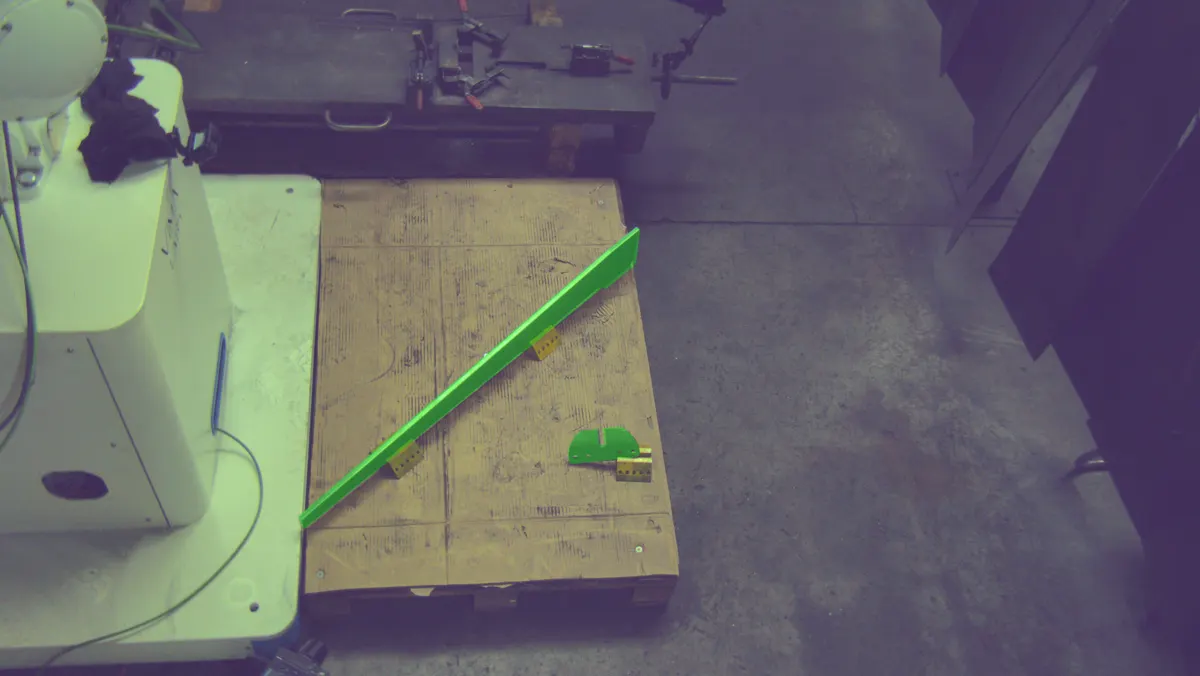
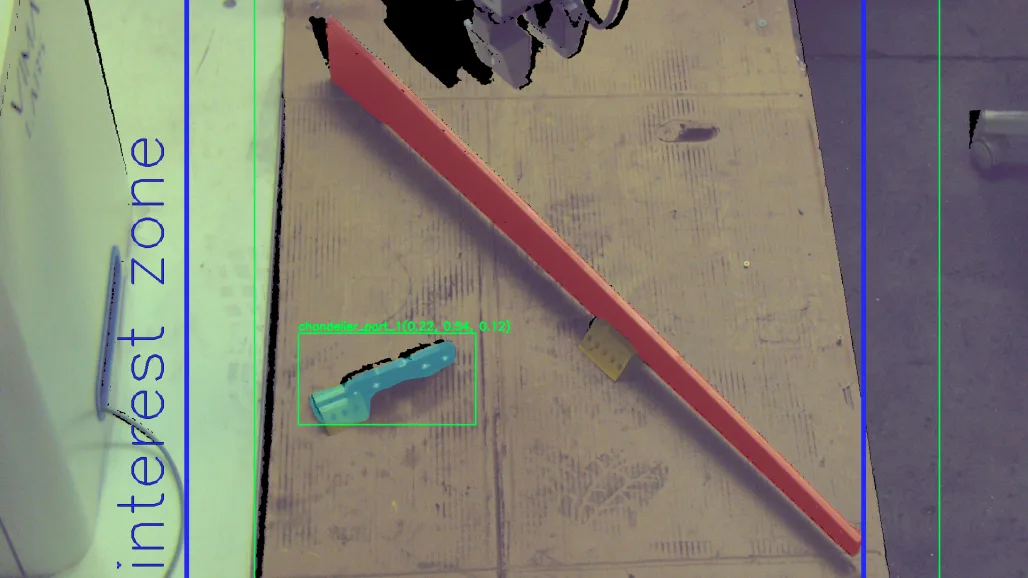
- 01AI perceptionVision models that identify and precisely locate each part.
- 02Motion planningMovements computed automatically in a digital twin, with no part-by-part programming.
- 03Manipulation and AIOur own AI models, trained on our data, to master contact-rich manipulation in variable conditions: grasping, insertion, fine adjustment. Robots that adapt to reality.
- 04Process integrationThe process (welding, assembly…) is driven by digital-thread data, from the part model all the way to the robot program.
Pillar 02 · Technology
Digital thread
Support for methods and engineering teams when industrialising parts. From drawing to routing and to the process on the shop floor.
- 01Capturing production dataEvery industrialisation, every production cycle generates data, collected and structured for reuse. Shop-floor know-how is no longer lost.
- 02Part drawing analysisAutomatic reading of 2D drawings and 3D models to extract geometry, dimensions and the operations to perform.
- 03Industrialisation supportRouting creation and quoting support, to move faster from drawing to shop floor.
Our CSR commitment
Social and environmental impact as a driver of long-term resilience
Local production
- Automate rather than offshore: activity and jobs kept in France.
- Less freight transport: a smaller CO₂ footprint.
- Local roots and industrial sovereignty.
Working conditions
- Fewer musculoskeletal disorders: the robot takes over heavy lifting and repetitive motions.
- A return to day shifts (1×8), strongly preferred over 2×8 and 3×8.
- Less strenuous work, a more attractive trade.
Who we are
Born in a workshop. Driven by research.
VimaLabs brings together the head of a metal fabrication SME and an R&D team of PhDs in AI for robotics and control. We develop and test our solutions inside a working production shop, near Nantes, France.


Emmanuel Gréau
Co-founder · CEO, entrepreneur and head of a metal fabrication SME

Simon Robert
Co-founder · CTO, robotics R&D engineer | Manufacturing engineering

Fadi Almasalmah
PhD in robotics, control expert
A team bridging industry and innovation to take on the challenges of flexible metal fabrication and welding.
Backed by
 French Tech Emergence grant



Contact
Let’s build the workshop of tomorrow together.
Investor, manufacturer, research partner: let’s talk about your project or our development.
- contact@vimalabs.com
- ADDRESS
- Rue du Croissel
44540 Vallons-de-l’Erdre, France - VimaLabs on LinkedIn